From Tokens to Policy:
Causal and Interpretable
Heterogeneous Treatment Effects
Identification
 2
2 3
3
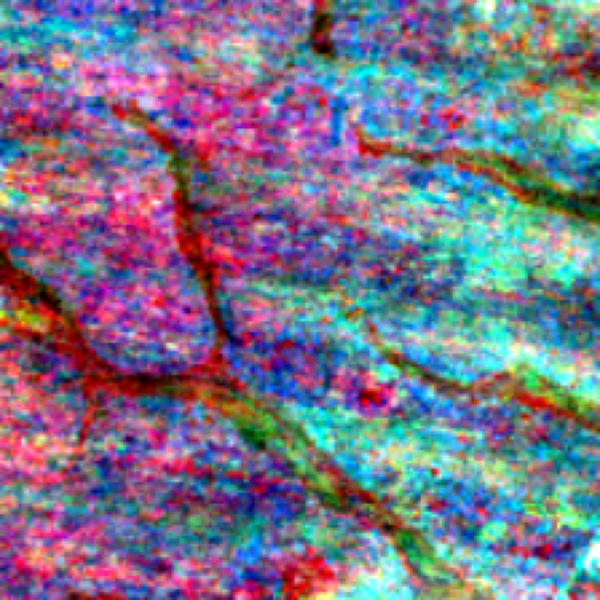
Satellite imagery surfaces candidate environmental drivers of anti-poverty program impact, unmeasured in surveys. Click to explore.




Introduction
Contributions
-
Causal and interpretable framework
More data doesn't help if we ask the wrong question. We distinguish variables correlated with treatment-effect heterogeneity from those that causally drive it, and formulate the search for the latter as a Markov-blanket discovery problem over a sufficient and aligned pre-treatment representation. We show when and how it is achievable end-to-end, from raw multi-modal measurements to interpretable policy hypotheses. -
New method
We introduce NEXIS, a forward–backward Markov-blanket procedure based on conditional CATE-equivalence tests: a forward step followed by one terminal backward step. It comes with a selection guarantee, and is extensively tested and ablated on semi-synthetic experiments, providing practical guidelines for different data regimes. -
New candidate discoveries in development economics
We deploy NEXIS on two anti-poverty program evaluations in Sub-Saharan Africa, extending both with satellite imagery to capture environmental modifiers. In both programs, the selected modifiers are mainly environmental factors, coarsely proxied or absent in survey data, while no individual-level demographic is selected. With no ground truth, these results are hypotheses for field validation, not established causal modifiers or policy prescriptions.
Experimental Power Paradox
It is a variable for which the treatment effect varies among its strata. Associated with how much a unit benefits from the treatment.
It is an effect modifier that causally drives the heterogeneity by directly interacting with the treatment. The complete set of direct modifiers is the minimal and sufficient summary of the effect heterogeneity, and has a causal reading: it identifies how the effect would change under an intervention on the modifiers.
Example: Consider a cash transfer program targeting mothers with a newborn, designed to increase the monthly household expenditure on infant care. Market access is a latent direct modifier — communities near markets can convert the cash into goods for the newborn more effectively. Road density, visible from satellite imagery, correlates with market presence and surfaces as an effect modifier, but only by common cause. A naive interpretation suggests building roads to amplify the program effect; the actual driver is market presence, so a road built where no market exists leaves the effect unchanged.
Marginal screening tests each variable on its own and cannot distinguish effect modifiers from interactors: as experimental power grows (larger samples, stronger effects, more sensitive tests), it flags every variable that carries heterogeneity signal, including non-causal proxies like road density. It is consistent for the wrong target: more power widens the gap from the direct modifiers, especially in learned representations, which are intrinsically entangled. Recovering the direct modifiers requires conditional tests.
Method
From Tokens to Policy explaining the effect heterogeneity
Procedure:
- Experiment. Design a controlled experiment, run and measure any candidate treatment interactors.
- Represent. Represent such pre-treatment measurements in an interpretable dictionary with minimal or no human supervision, e.g., training a Sparse Autoencoder (SAE) on a frozen domain-specific foundation model.
- Identify. Neural EXposure Interaction Search (NEXIS) retrieves the minimal and sufficient heterogeneous effect characterization by conditional CATE-equivalence tests on the representation coordinates, adapting forward–backward Markov-blanket discovery:
- Forward step (IAMB’s grow phase): given the current selection S, add the coordinate with the smallest p-value if it passes the gate α/|S̄|, where S̄ are the coordinates not yet selected; repeat until no coordinate passes.
- Terminal backward step (MMPC/HITON-PC subset rule), run once: keep a selected coordinate j only if its p-value is at most α/m given every subset of the other selected coordinates, with m the number of candidates.
Theorem (Causal Identification)
In a randomized experiment, with faithfulness and valid and consistent CATE-equivalence tests, assuming Principal Alignment of the representation, NEXIS’ output Ŝn recovers the principal proxies S* of the direct effect modifiers (selection guarantee):
lim infn P(Ŝn = S*) ≥ 1 − α
If we further assume Measurement and Representation Sufficiency, the principal proxies identify the causal and interpretable heterogeneity characterization (causal identification):
τdo(Wdir) = τ(Wdir) = E[τ | ZS*] almost surely - Policy. Update the policy accordingly, e.g., the treatment assignment of the next program iteration. Structural assumptions determine the causal reading, so discoveries call for cautious interpretation and experimental validation first.
Controlled Experiments — CelebA Benchmark
Check Principal Alignment
Case Study 1: Youth Opportunities Program (Uganda)
Program. The Youth Opportunities Program (YOP) is an anti-poverty program launched in 2008 in post-conflict Northern Uganda, awarding cash grants (approximately $382 per group member, plus optional vocational training) to self-organised youth groups, randomized across 535 groups. The original evaluation reports a positive average effect on productive economic capacity, captured through skilled employment and business asset accumulation. We ask why and how the impact varies.
Experiment. Our analytic sample has 2,082 individuals in 439 groups and 327 distinct communities (331 RCT sites) across four sub-regions (Karamoja, Teso, Lango and West Nile), 825 of them treated. Outcomes are skilled employment and log business assets at endline; pre-treatment covariates include age, sex, parental education, the group share of women and the community language group (7 ethnolinguistic clusters). We define the treatment T as grant receipt: 29 of the 265 groups assigned to the grant never received it and count as untreated. This exploratory as-treated analysis assumes non-receipt is as good as random.
Data fusion (ours). We extend the trial with Landsat-7 multispectral imagery (2005–2007 composite, immediately before the program), embedded via Prithvi-EO and summarised by a 1,024-atom TopK SAE trained on a held-out Uganda national grid. The 146 atoms active in at least 5 sites, 12 spectral-index summaries (NDVI, NDWI, MNDWI, NDBI, EVI, BSI; mean and standard deviation per tile) and the trial covariates form 170 NEXIS candidates. The map below shows the trial communities by treatment, outcome or covariate.
Results
Certified modifiers are selected by the forward step and survive the terminal backward step; candidate modifiers are selected by the forward step only. Both are hypotheses: exploratory findings to be investigated further, since whether the requirements of NEXIS’s guarantee hold in practice cannot be verified here.
| Modifier | GATE active | GATE inactive | Δ | Marginal p | Certification p |
|---|---|---|---|---|---|
| Certified modifiers | |||||
KaramojongLanguage group. Karamoja was conflict-affected at trial time, under a government disarmament campaign through 2011, with weak supply-chain integration. The estimated effect on skilled employment is null in these communities. Hypothesis: without functioning markets, the grant does not compound into skilled trade. | −0.030 (0.060) | +0.372 (0.022) | −0.403 (0.063) | 7.7×10⁻¹⁰ | 7.6×10⁻⁸ |
PallisaLanguage group covering Pallisa district, outside the northern conflict core in eastern Uganda, with a mixed Iteso–Bagwere farming economy and shorter supply chains to central markets. The estimated effect is the largest among the selected modifiers. Hypothesis: where markets had recovered, the grant compounds into durable skilled employment. | +0.674 (0.058) | +0.288 (0.022) | +0.386 (0.062) | 6.3×10⁻⁸ | 1.0×10⁻⁴ |
Vegetation spatial heterogeneitySatellite atom (neuron 533): a mosaic of agricultural patches and bush. Hypothesis: where land cover is varied, households can sustain mixed subsistence livelihoods, reducing the pull of a new skilled trade (outside-option logic). | +0.214 (0.038) | +0.373 (0.025) | −0.159 (0.045) | 6.7×10⁻⁵ | 2.7×10⁻⁴ |
| Candidate modifiers | |||||
LugbaraLanguage group of West Nile, historically isolated from national infrastructure, underserved by post-LRA reconstruction flows and constrained by its position at the DRC and South Sudan border. The estimated effect stays positive but well below the rest of the sample. A candidate: its certification p-value exceeds α/m. | +0.092 (0.061) | +0.347 (0.023) | −0.255 (0.065) | 1.6×10⁻⁵ | 3.2×10⁻⁴ |
Perennial river presenceSatellite atom (neuron 339): sites along permanent watercourses. Hypothesis: river corridors keep fishing and subsistence farming viable, reducing the pull of a new skilled trade (outside-option logic). A candidate: its certification p-value exceeds α/m. | +0.089 (0.097) | +0.330 (0.021) | −0.242 (0.100) | 2.1×10⁻⁴ | 4.4×10⁻⁴ |
Case Study 2: Livelihood Empowerment Against Poverty (Ghana)
Program. The Livelihood Empowerment Against Poverty 1000 (LEAP 1000) programme was launched in Ghana in 2015 to target early-childhood poverty and stunted nutrition, providing bimonthly cash transfers to extremely poor households with newborns. Its evaluation uses a regression discontinuity design on a proxy means test score, with difference-in-differences estimation between the 2015 baseline and the 2017 endline.
Experiment. The evaluation covers 2,331 households (1,185 treated) in 162 communities across five districts in two regions, Northern and Upper East (region boundaries as of 2015; the map shows today’s regions). The outcome is monthly adult-equivalent household consumption expenditure, and 24 pre-treatment survey covariates describe household composition, the household head, housing, water and sanitation, and livelihoods. The difference-in-differences estimate of the local average treatment effect on the treated (local ATT), for households near the eligibility cutoff, is +7.35 GH₵/month.
Data fusion (ours). We extend the evaluation with Landsat-8 2015 imagery, embedded via Prithvi-EO and summarised by a 4,096-atom TopK SAE trained on a held-out Ghana national grid. The 131 atoms active in at least 5 communities, 12 spectral-index summaries and the 24 survey covariates form 167 NEXIS candidates. Standard errors are clustered by community. The map below shows the GPS centroids of the 162 communities.
Results
Certified modifiers are selected by the forward step and survive the terminal backward step; candidate modifiers are selected by the forward step only. Both are hypotheses: exploratory findings to be investigated further, since whether the requirements of NEXIS’s guarantee hold in practice cannot be verified here.
| Modifier | GATE active | GATE inactive | Δ | Marginal p | Certification p |
|---|---|---|---|---|---|
| Certified modifiers | |||||
Ephemeral waterwaysSatellite atom: narrow seasonal streams with adjacent vegetation. Active in 6 communities (83 households). Hypothesis: in Northern Ghana’s rainfed smallholder system, seasonal water allows micro-irrigation of adjacent plots, and the transfer can be invested in seeds, fertiliser or tools that water-adjacent households can put to productive use. In paired 2015/2017 imagery, the VLM reports cropland expansion in five of the six communities, with compact patches of local NDVI increase in four of them. |
+42.9 (15.8) | +6.0 (3.9) | +36.9 | 3.2×10⁻⁸ | 3.2×10⁻⁸ |
Closed-canopy forestSatellite atom: dense, continuous forest canopy, a rare endowment in this predominantly savannah landscape. Active in 5 communities (42 households). Hypothesis: forest-adjacent households access non-timber forest products, fuelwood and forest-edge cultivation, so the transfer can go beyond emergency food purchases toward dietary diversity or productive assets. The large estimate may also reflect selection of forest-proximate communities. |
+56.2 (19.7) | +6.4 (3.9) | +49.8 | 2.0×10⁻⁵ | 2.0×10⁻⁵ |
Take Aways
Citation
@article{cadei2026nexis,
  title   = {From Tokens to Policy: Causal and Interpretable Heterogeneous Treatment Effects Identification},
  author  = {Cadei, Riccardo and Otchere, Frank and Tirivayi, Nyasha and Angeles Tagliaferro, Gustavo and Bargagli-Stoffi, Falco J. and Locatello, Francesco},
  year    = {2026},
  url     = {https://arxiv.org/abs/2606.17010},
  note    = {Under review}
}